Wednesday, October 21, 2015

New Photo of School Benefactor is Gift

A small box from the estate of the late Luella Crawford Dodds (1879-1978) who was among the 24 graduates of the 1898 class at Western Reserve Academy arrived at WRA Archives a short time ago.  It had been hiding in the attic of a Hudson house for the last 35 years.  Among the little treasures of this collection include some diaries that Luella kept, a number of clippings from the local paper, and a couple of rare photos of James W. Ellsworth and his wife, Julia.
Luella Crawford Dodds had become the travel companion of Mrs. Ellsworth around 1910 and remained with the Ellsworth household until the death of school benefactor James W. Ellsworth in 1925.  Her frequent travel to Europe or to Jekyll Island, Georgia, with the Ellsworths was quite a contrast to the other young women who grew up in Hudson at the end of the 19th century.  Luella must have had the charm and panache to mingle in the society that the Ellsworths kept.  One photo shows Luella with Mrs. Ellsworth at the Schloss Lenzberg in Switzerland in August, 1920.  It is interesting but not as good as the one taken around the same time at the Villa Palmieri, the Ellsworth home at Florence, Italy.
The photo of Ellsworth himself and his wife was probably taken in Switzerland around 1914 and shows them both posing on a rustic staircase in what appear to be seersucker outfits, appropriate for summer season. Ellsworth is wearing one of the Lenzberg straw hats that he sported during his summers abroad.  This same hat appears on a Swiss postage stamp of our era.
Luella came back to Hudson in 1925 and lived with her husband on Owen Brown Street where she remained for more than 30 years.  She served on the Board of Trustees at the Hudson Library and Historical Society for over 60 years and was active at Christ Church Episcopal where she was cashier for the church's annual fall rummage sale.  She lived in a house on North Main in her later years, liked strong cocktails and cigarettes, and always wore a hat.  Alice Stark of WRA recalled her attending a function on campus around 1975 where she was "seated bolt upright on a Victorian sofa, sipping tea and smoking a cigarette at age 95, the only person in the room wearing a hat".  We are pleased to add these items from an unforgettable alumna to the collections of WRA Archives.

Friday, November 21, 2014

The Archives Makeover

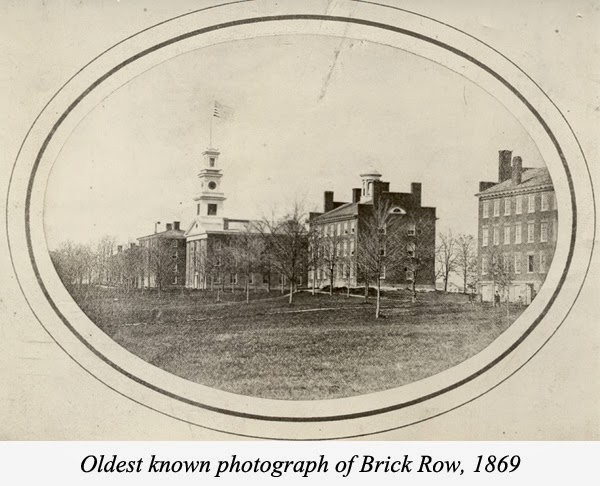
It was a pleasure working with designer Inga Walker on posting historic photos in the hallway outside the WRA Archives on the lower level of the John D. Ong Library. We examined a number of vintage photos and made a selection of the ones we hoped would be of interest to visitors and alumni. The oldest photo shows the campus buildings in the late 1860's with a heavy fence on the College Street side of Brick Row.

Another photo on the walls is one of student cadets ranged in front of the Chapel in the late 1870's when military drill was a part of the curriculum. Other photos show a girls' basketball team from the early 1920's, a baseball team with coach "Doc" Frew from the 1930's, two photos of the Senior Cabin built in the East Woods in 1928, and an interior chapel photo from the 1940's showing Headmaster Joel B. Hayden at the podium with the beautiful Palladian windows behind him. In all there are 15 photos in the hallway, each with an explanatory tag.

We invite all visitors to the school to come down to the lower level of the John D. Ong Library to see this photo collection, as well as visit the Archives. Some other items of historic interest have been framed for the adjacent College Counseling Office and should also be included in the visitor tour.

Tuesday, October 14, 2014

A History of WRA

I am contacted often regarding Western Reserve Academy's history. Here is a brief overview of major WRA happenings. Please do contact me for additional details not provided here. Ours is an exciting and unique history on many levels.

Western Reserve Academy in Hudson, Ohio, was founded in 1826 as the preparatory school for the Western Reserve College, located in Hudson from 1826 until it moved to Cleveland's University Circle in 1882. The school became autonomous, then completely independent, of what is now Case Western Reserve University in Cleveland. There is no current connection between our two institutions except for a common founding date, and the fact that our school now occupies the historic buildings that once were the seat of the old college.

The earliest buildings were constructed starting in 1826 with the building of Middle College, where the cornerstone was located, and which served as a dormitory from its completion in 1827 until its demolition in 1912. South College, which was the home of the old Preparatory School, was built in 1829-30 and continued to be the main classroom and dormitory building for the school until the college moved to Cleveland. This building was demolished in 1884. Both of these were on Brick Row, that line of buildings facing west that were modeled loosely on the Brick Row at Yale College in New England. In fact, during the 1840's and '50's, the old college liked to call itself "the Yale of the West."

The historic Brick Row consists of several buildings lined up on the ridge facing west in order to best catch the sunshine that was needed to light 19th century structures. Lemuel Porter, who had emigrated from Waterbury, CT, and had built the wonderful Church at Tallmadge Circle (1825), was hired as the architect/ builder for the campus of the old college. He had completed the two buildings described above, and was just finishing up the duplex President's House (1829-30) when he died suddenly in the fall of 1829. The college trustees decided to extend the contract to his young son, Simeon Porter (1807-1871).  He was only 22 years of age, but had worked as an apprentice to his father on his college projects.

Using the plans of his father, often based on the models in the Asher Benjamin pattern books, Simeon Porter completed the work on Brick Row and then went on to a distinguished career as an architect in Cleveland. Simeon and his father were responsible for introducing the Greek Revival style to Hudson and this campus, and the Brick Row is an excellent example of this important architectural style.

Simeon Porter completed the majestic Chapel (1836); the North Hall dormitory (1838), one of the oldest in Ohio; Loomis Observatory (1838) based on the plan of astronomer Elias Loomis (1811-1889), who had gone to Europe to purchase the instruments that are still in this little building. Loomis Observatory is now the 2nd oldest in this country, the only one older is also an 1838 structure at Williams College in Massachusetts. Simeon also built the Athenaeum (1843) on the north campus that was the main classroom building on campus until the completion of Seymour Hall (1914) on the Brick Row. He also helped build the Nathan Seymour House (1842) on Prospect Street, used as a guesthouse. The other building on WRA's historic Brick Row is the John D. Ong Library (2000), designed to fit into the line of historic buildings on this walkway.

James W. Ellsworth (1849-1925) was the multi-millionaire Hudson man who became the chief benefactor of the town during the 20th century and the principal benefactor of Western Reserve Academy which "reopened" on his foundation in 1926. It was his gift that saved the school and its historic buildings, which might otherwise have been demolished, as the school itself went bankrupt in 1903. Ellsworth is the man who rescued the school and put it on a sound financial basis which is why it is one of America's leading independent schools.

You can read about the early history of this campus in Frederick Waite's Western Reserve University, the Hudson Era (1943) which should be available for loan from your local library. Additional historical significant articles are also always available by reading my archival blog postings.

Friday, September 19, 2014

Connections from Australia show WRA's global reach


A paraphrase of a blog visitor's request:

I came across your name on the internet (WRA: Past & Present), and wondered if you could help me. I live in New South Wales, Australia. I am a distant relative of William Pettingell via his older brother Joseph Pettingell. I have been informed that there was a portrait of William Pettingell in the dining room of Nathan P Seymour House - Campus Guest House, Western Reserve Academy. If this portrait is still hanging in Nathan P Seymour House, is there any way I could get a copy? I would be very grateful if you could reply to my email. I can provide you with a PDF of the diary, if you are interested.

And my subsequent response:

How nice to hear from one of William Pettingell's relatives in Australia, and to know that you contacted us as the result of our blog, WRA: Past & Present.


Yes, we have that portrait of William Pettingell which has been hanging in the dining room of WRA's guest house, the Nathan Seymour House on Prospect Street, since it was opened as a guest house in 1998. I will have that image scanned and sent to you probably later today (Monday).


It may interest you to learn that over the years we have had correspondence with other family members of the Pettingell family. In early 1999 I corresponded with Robert O. Pettingell of Greenville, Texas and sent him a packet of information about William Pettingell (1802-1885) and his association with the old college that was located here in Hudson. Rob then sent me a packet of family information that included the names and addresses of the following, some of whom may be directly related to you. They included Mike Linden of Taupo, New Zealand; Betty Hargreaves of Albion Park Rail, NSW, Australia; Wal Taylor of Muskisson, NSW, Australia; and Mrs. Helen Boyd of Northbridge, NSW, Australia.

A little earlier, my colleague from Case Western Reserve University in Cleveland, Rich Baznik, sent out a large packet of letters from Pettingell to various family members, his wife and others, from 1843 to 1857 that are in the Archives of CWRU or borrowed from private owners with copies in the CWRU Archives. This packet was sent to a Linda Pettingell whose location is unknown to me. Rich also corresponded with Robert O. Pettingell of Texas who was probably sent the same packet of letters, many of them datelined Hudson, Ohio.

Hudson also became the home of William's brother Joseph's grandsons, artist Alfred Pettingell whose nature paintings are in the collection of The Hudson Library and Historical Society where I was library director at the time those paintings were restored. I believe that several are now on exhibit at the library.

Joseph Pettingell, (1879-1964) the other grandson who settled here, kept a diary that tells about Hudson life in the 1880's and 1890's and which was published in a limited edition volume several years ago and is available at the Hudson Library, His widow, Maude S. Pettingell (1880-1980), lived on Oviatt Street for much of her life, and was a special education teacher in Cleveland and Columbus. She and her husband, Joseph, had an extensive shell collection that they donated to the Cleveland Museum of Natural History. Let me know if any of these items would be of interest to you, and I will make copies and send to you via surface mail. For that I will need a street address. Meantime, I will have that portrait scanned and sent along to you.

Yes, we would be interested in seeing the Diary of Joseph Pettingell as transcribed by his grandson, Joseph, and yourself. If you are able to send us the link to the National Library of Australia, we would add this to our records. Thanks again for contacting Western Reserve Academy.

Our connections at WRA are global and so valued.

Thursday, March 20, 2014

Guest post from alumnus Lawrence B. Siddall ’48

Class of 1948 member Lawrence Siddall recently submitted an essay for our community, writing the speech he'd give to our student body in the Chapel, if able to travel to WRA. Mr. Siddall is a retired psychotherapist and a former Peace Corps volunteer, and his essay is a wonderful reminder of how connected our community is throughout the ages. Thank you Mr. Siddall!
What I Would Say if I Were to Give a Talk in the Chapel
By Lawrence B. Siddall ’48
Greetings to you all. It is a real pleasure to be with you today. I spent three years at Reserve, graduating in 1948. Here it is 2014. It’s hard to believe that it has been more than 65 years since I sat where you are in this historic chapel. That means I’m 84 this year, old enough to be your grandfather. It makes me think that if, in 1948, we had an alumni member give a talk who had graduated 65 years before, he or she would have been from the Class of 1883. That would have seemed like ancient history to us. You may be thinking the same thing about me. Incidentally, 1883 was one year after the Trustees of Western Reserve College, which was founded on this campus in 1826, decided to move the college to Cleveland.

Do you know where the term western reserve comes from? It’s connected to the state of Connecticut, which in colonial times had land claims that stretched westward into what would become Ohio. These claims in northern Ohio were collectively known as the Connecticut Western Reserve. Much of the territory was wilderness and home to American Indians. It must have been a huge challenge for David Hudson and his fellow Connecticut pioneers to make the trek out here and settle this town in 1799. 

Read entire essay here... 

Wednesday, March 19, 2014

The Lincoln Chair celebrates 100 years in Hudson!

This month marks the 100-year anniversary that James W. Ellsworth brought Lincoln's chair back to Hudson.
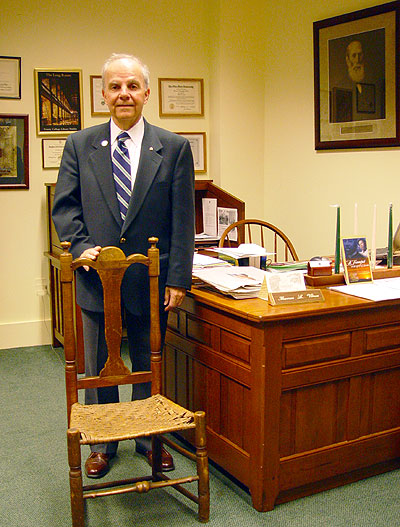
Archivist Thomas Vince with Lincoln's chair.

Western Reserve Academy's benefactor, James W. Ellsworth, was just 12 years old when Abraham Lincoln's train stopped in Hudson in 1861. We believe he was there, as it would have been a great occasion for the town that had voted solidly for Lincoln in the election of 1860.

Ellsworth attended our school in the late 1860s, and when his son was born in 1880, he named him Lincoln Ellsworth. After his retirement to Hudson, James W. Ellsworth rescued and reopened WRA, shaped and restored the campus, and eventually left his entire fortune to endow the school. And along the way, he became quite a collector of American antiques and implements which also were willed to the school. Among his treasured items is a chair that once was in the chambers of the Lincoln and Herndon Law Office in Springfield, Illinois. Ellsworth bought it at auction in March, 1914. It now can be seen in the WRA Archives.

Our Loomis Observatory founder's descendant visits campus

Doc Loomis of Medina County, a descendant of the founder of WRA's Loomis Observatory, visited the WRA archives and the 175-year old building last spring. Loomis, a missionary Bishop with the Anglican church, brought some genealogical books to share with WRA Archivist Tom Vince, who had extended the invitation. Loomis was amazed at how much material about Loomis and the Observatory is in the Archives. Opened in September, 1838, the landmark building was 175 years old this fall.
Outside the door of the historic Loomis Observatory are visitor Doc Loomis with Archivist Tom Vince.
At the transit telescope, one of the instruments Loomis bought in England, are visitor Doc Loomis with WRA Archivist Tom Vince.

Tuesday, February 11, 2014

Seymour Hall -- A History of the Name

James W. Ellsworth
Some time ago, our Assistant Head of School for Advancement Mark LaFontaine asked me about the naming history of Seymour Hall.

School benefactor James W. Ellsworth (1849-1925) was the owner of the WRA campus starting in 1912, and eventually was able to reopen WRA as a boarding school (as it had been before 1903) in 1916. He was responsible for the corporation of trustees who operated the school and retained the naming rights for himself.
Seymour Hall
Ellsworth ordered the demolition of Middle College (1827) in 1912 which stood on the location of the present Seymour Hall. The building was designed by Ellsworth's architect, J.W.C. Corbusier, who gave the campus a large, high style Georgian building that would nicely blend with the 19th century Brick Row structures like the Chapel and North Hall. The building was announced at the end of 1912, and ground was broken in 1913 (100 years ago this year), and finished in 1914. It was named for the Seymours, father and son, who had been favorite classics professors during the day of the old Western Reserve College. Nathan Perkins Seymour (1813-1891) had built the handsome house on Prospect Street in 1843 which is used as the school's guest house. Professor Seymour spent fifty years on our campus teaching first at the old college, then as a kind of adjunct to the Academy after the college moved to Cleveland.
Nathan P. Seymour House
Nathan's son, Thomas Day Seymour (1848-1907) was born here in Hudson and was a year older than his boyhood friend, James W. Ellsworth, and probably attended the old Prep School with him in the 1860's. We know that they were close friends from a memoir written by Thomas Day Seymour's sister. He taught classics at the old Western Reserve College from 1872 to 1880 before moving on to Yale where he spent the rest of his life. He died at New Haven about the same time that his friend, James W. Ellsworth, returned to Hudson and determined on a course that would give him control of the WRA campus. There is no question that Ellsworth intended to honor the memory of the two Seymours with the construction of this academic building.

Ellsworth also was responsible for the restoring of all the historic buildings on our campus, and besides the erection of Seymour Hall, he also built the Bicknell Gym (1920), named for his close associate and WRA Board President Warren Bicknell, and Cutler Hall (1922), the large dining hall and dormitory at the corner of College and Prospect which Ellsworth wanted to be named for Carroll Cutler, President of the old Western Reserve College (1871-1886). Trustees decided to name this building in honor of the man who saved the school, James W. Ellsworth.

His insistence that these new buildings honor the great instructors of the 19th century was part of his way to instill a sense of tradition into his new venture.

Charles Seymour, the son of Thomas Day Seymour (1848-1907) became President of Yale University in 1937 and visited our campus while he was in office in order to see the house built by his grandfather and where his father had been born and grew up. At the time the Seymour House was owned by the Spangler family (1907-1948) not by the school itself. But his visit to the campus is noted in the Reserve Record. Charles Seymour served as President of Yale until 1950.

Tuesday, September 10, 2013


Recently, I received an inquiry about faculty member Robbie Robinson as the result of a gift received by Western Reserve Academy.


Irving L."Robbie" Robinson was on the WRA faculty as a master of French from 1953 to 1967, and left the same year that Headmaster John W. Hallowell retired to New England. Robbie went on to Groton School in MA and taught there for four years, resigning in 1971 and going off to France where he turned up dead on a beach in Corsica. He was 44 at the time of his death, and was much mourned on this campus where he was a very popular teacher and dorm master.


George Birnbaum '66 wrote a fine article about Robinson that was published in the Alumni Record along with five photos of this "forever young" teacher. Former Headmaster John W. Hallowell, who would die in a mysterious car accident in 1980, led the mourners in a service at WRA Chapel on October 30, 1971. A memorial grove of trees near the intersection of Oviatt Street and Aurora Street was to be his permanent memorial on campus. According to the article in WRA's Alumni Magazine, there were 178 donors to the fund (all are listed), an outpouring of admiration for a former faculty member that is almost unprecedented.


Born in 1927, Irving L. Robinson grew up in Olympia, Washington, where he went to high school, followed by college at Yale University. He graduated in 1947 at the age of 20. He would later enter Laval University at Quebec City in 1955 and spend the next several years working summers toward a master's degree (maybe some doctoral work as well). According to records in WRA Archives he was awarded a master's at Laval in 1966 just a year before he left WRA. It is interesting to note that Headmaster John W. Hallowell had identified Robinson as a likely faculty candidate while Robbie was still a resident at Jonathan Edwards College at Yale. Robbie came out to Hudson in April, 1947 to meet some faculty and to look at the campus, but ultimately he accepted a position at the Menlo School (independent school) in Menlo Park, California.

But Hallowell kept pursuing Robinson who finally agreed to join the faculty in 1953 and where he became quite a legendary character both as a teacher of French and as master at North Hall. I found the connection with John W. Hallowell an unusual one, and in 2009 contacted Groton School in MA regarding Hallowell's teaching years there before World War II in preparation for an article I wrote for the Alumni Magazine. I happened to speak with Doug Brown, Archivist for Groton, who had started there as a teacher in the 1970-71 year and had known Irving Robinson. He brought up the subject because he knew that Robbie had come to Groton from WRA. Brown reported that Robbie had resigned from Groton in the spring of 1971 and had "sold all his worldly goods" before departing for France where he died a few days after his arrival on a beach in Corsica.

Doug Brown of Groton posed the question about whether it was suicide or perhaps a drug deal gone wrong. In any case Robbie was known to be a strong swimmer, yet he died of drowning. The U.S. State Department ordered his remains be cremated without any positive identification by a family member or friend. Doug Brown stated that Robinson's case is still a mystery. He told me that someone with a WRA connection had inquired about Robbie, probably in 2008. My contact with Groton was in October 2009.

There used to be a marker inside the lobby of Wilson Hall before it was renovated in 2001. This marker (I have two photos of it in the Archives) is headed The Irving Lind Robinson Grove, and notes that a grove of trees was planted in his memory "to the east of this building" in the spring of 1972. The marker is now attached to a boulder and sitting under one of the trees in the Irving Lind Robinson Grove. You can see the marker just a few feet from where you turn into the parking lot off Oviatt Street to go behind Wilson Hall. I checked it out on my lunch hour and will add this information to the Robinson file.

I also took note that during his residency on the WRA campus, Robinson planted ivy outside the Chapel door and the plantings around North Hall where he lived. They have since been replaced, but the grove of trees looks healthy and strong.

In any case there are plenty of alumni who still have fond memories of Irving L. "Robbie" Robinson. A Plain Dealer article and a similar one in the Akron Beacon Journal, both dated July 8, 1971, note that Robinson's death in Corsica was being investigated. The Beacon reported his family as his mother, Mrs. John S. Robinson of Seattle, widow of a Washington Supreme Court justice; brothers Sam W. of Mercer Island, WA and John S. Jr. of Olympia.

Tuesday, May 07, 2013

Papal letter finds home in WRA Archives

Archivist Tom Vince with Papal letter
When the Mary B. Eilbeck Graphic Arts Collection was established by WRA Board of Trustees member and school benefactor William D. Shilts in 1962, he intended for the school to acquire examples of printed materials from every age. For many years this collection, which honored the first librarian of the school, Mary B. Eilbeck, who served from 1924 to 1945, was housed in the Lucien Price Room on the upper floor of Wilson Hall. Although most of that collection was disbanded in the late ‘90s, a few items remain and are housed in WRA Archives.

One of the most interesting items is the Papal letter on 27 pages of vellum manuscript, written in Latin, signed and dated by Pope Martin V (1417-1431). The folio manuscript was written for the Congregation of San Bernardo in Spain which had split from the Cistercian Order in 1425. Although we are uncertain about exactly when this came to the WRA Library, it is certain that either art instructor Bill Moos or history legend J. Fred Waring acquired this item as they were the two faculty members authorized to find and purchase such treasures for the school.
View from the 27-page vellum manuscript

What makes this late medieval manuscript even more interesting is that Pope Martin V was the pope who succeeded Gregory XII, the last pope to resign prior to the recent resignation by Benedict XVI. The references to the last time a pope had resigned are to this leadership change nearly 600 years ago. Pope Martin V was a member of the distinguished Colonna family, a man of integrity, a former Papal diplomat, and brought an air of stability to the papacy which had been subject to schism and scandal. Pope Martin began the restoration of the city of Rome and ushered in the Renaissance style. His letter to the monks in Spain is unfinished, which may account for the reason why it was on the market rather than in the Vatican Library.

The appraiser who examined this manuscript in 2009 declared it to be “unique and important” as well as “an excellent calligraphic example of medieval writing with many flourishes above and below the text and with much marginalia”. Although its value is nominal, we consider this item to be one of the amazing treasures of the school. It has never been translated into English, a project some student of Latin may wish to do one of these days.

Tuesday, April 23, 2013

The David Hudson Portrait

David Hudson portrait
The story of the David Hudson portrait by J. O. Osborne, painted in 1851, is one of unusual dimensions and locations. It was commissioned by Hudson’s daughter, Anner Maria Hudson Baldwin (1800-1892) for a place of honor in the old Board Room on the upper floor of the Athenaeum, where the college trustees met until the college moved to Cleveland in 1882. The portrait was probably not taken to Cleveland, as there is documentation that the trustees voted to return the portrait to David Hudson’s daughter and her daughter, Mrs. Edwin S. Gregory “in deference to their wishes."

How it was found for sale in a Florida antiques shop some 85 years later is something of a mystery.

In 1967, Mr & Mrs. Benton F. Murphy of Chagrin Falls found the portrait at an antiques shop in St.
Dr. Henry Flanagan and Mr. Benton Murphy
with the David Hudson portrait in 1991.
Augustine, Florida, and saw the back of the portrait was identified as David Hudson. The Murphys recognized the founder of Hudson, Ohio, and purchased the portrait, which remained in their home until 1991. They decided to present the portrait as a gift to Headmaster Henry “Skip” Flanagan of Western Reserve Academy. The Murphys had had the portrait restored and learned from the Bonfoey Gallery in Cleveland that it had been painted by noted portrait painter J. O. Osborne at “the request of the trustees of Western Reserve College for use of the cabinet.” Although the Murphys themselves had no previous connection with the school, they wanted the portrait to come home to the campus for which it had been created in 1851.

Archivist Tom Vince showing off the
David Hudson portrait's new home in the
John D. Ong Library.
The portrait shows David Hudson (1761-1836), presumably at the height of his career as Hudson’s founder, township trustee, Postmaster, real estate baron and founding trustee of the Western Reserve College. He is about the age of 60 and is shown standing next to a book-laden desk holding a document that suggests his civic importance. It is a far more sophisticated portrait than the one done by James Beard in 1829, the large matching portraits now owned by the Hudson Library and Historical Society. The smaller bust portrait, originally owned by Miss Virginia Lee, last Hudson descendant to live in the David Hudson House, was given to the school in 1967. That earlier portrait hangs in Ellsworth Hall. The Osborne portrait, given by the Murphy family in 1991, hung for many years in the hallway opposite the former Headmaster’s Office in Seymour Hall. It was later taken to the attic of Seymour where it languished until being rescued by Archivist Tom Vince in the spring of 2013 and hung on the lower level of the John D. Ong Library next to the large 1856 map of Hudson that this same archivist discovered several years ago, tucked under the eaves of the attic in the Knight Fine Arts Center. The large David Hudson portrait now has a place of honor sharing the wall with a historic map of the town he founded.

Tuesday, April 16, 2013

WRA Commencement Invitations


NOTE: Thank you to all my loyal followers. I have several new things to share, so check back often for the latest postings!

1887 & 1889 Commencement invitations
As the result of an inquiry from Nancy Forhan of the Pioneer Women's Association, we checked into our file of commencement invitations and announcements from the 19th century. While the college was still on its campus in Hudson, the old Preparatory School did not have a ceremony of its own. Hence, someone like Henry H. Hosford (1859-1965) of our class of 1876, did not have a commencement until he graduated from the old college in 1880. The college moved to Cleveland in 1882, and that year the old Prep School took on its new identity as Western Reserve Academy.

1890 Commencement invitation
The first WRA commencement was held in the Chapel in June, 1883, with all thirteen students participating in the ceremony either as speakers or performers on musical instruments. This was during the regime of Headmaster Newton B. Hobart, and for the next several years this was the pattern of commencements held at Western Reserve Academy.  Hobart’s successor, Dr. Frederick W. Ashley, decided to change the order of business at the annual commencement. Instead of having the students each giving a talk or performing a musical piece, Ashley introduced the commencement speaker as a feature of the ceremony, followed by the awarding of diplomas. The first outside speaker was Dr. Charles F. Thwing, President of Western Reserve University in Cleveland who spoke in June, 1893. WRA had its first female commencement speaker in 1895 when it welcomed to the Chapel podium Miss Mary Evans, Principal of Lake Erie Seminary in Painesville (later to become Lake Erie College.) In the last year of Ashley’s tenure at the school, 1897, a student activity was introduced in the form of the “Ivy Ode” and the “Ivy Oration,” each to be given outside the Chapel. No text remains of this sweet student tribute to the school.
 
1902 Commencement invitation
and  commencement week
calendar of events
Invitations as well as announcements that were intended for mailing cover the era of 1883 through 1903 when the school closed for bankruptcy.  Some of these announcements are fairly elaborate with ribbons and other decorations that indicate the scale of importance these commencements had to the students and families of that era.

Monday, May 17, 2010

Potwin House Renovation recalls Professor who lived there

For the last several months, a major renovation has been going on at the historic Potwin Cottage on Hudson Street, probably the first total renovation in many years. An old marker that will likely be re-attached to the front of house proclaims that Professor Lemuel S. Potwin lived in the house from about 1873 until 1882 when he moved to Cleveland with the old college.

Born in Connecticut in 1832 and a graduate of Yale College in 1854, Potwin went on to theology school, was ordained, served as a Pastor, teacher, and editor of the New England magazine before coming to Hudson in 1871 to teach Latin and also English language and literature. He and his wife, Julia, lived in this house during most of their time at Western Reserve College, and Professor Potwin wrote a number of books and articles while living here. He wrote widely about the New Testament, free will, and the pronunciation of Latin. When the college moved to Cleveland, the Potwins followed and the Professor continued teaching up to the time of his death in 1907. A selection of his essays and reviews was published by a Cleveland bookstore shortly after his death.

In the summer of 1897 Professor Potwin and his wife, Julia, sailed for Europe for what appears to have been a sabbatical of sorts. They sailed on a small luxury liner, the S.S. Mohawk, and spent the next fourteen months in Europe, returning in September, 1898. The couple kept a journal of their travels and made a pact that the surviving spouse would publish the journal after one of them died. So after Potwin's death, his widow Julia edited their journal and published it privately in 1911 under the title Fourteen Months Abroad.

The house on Hudson Street was built around 1852 by the Kennedy family who sold it to the college several years later for use as a faculty residence. The house is Greek Revival in its basic design and originally had just one small wing off to the left which was raised to two stories in the early 1960's. Another addition was added to the rear of the house about the same time. When the college left the campus to the academy, our school continued to use the house as a faculty residence. So "dear old Professor Potwin", recalled by students of that era as being somewhat eccentric, has had his name attached to this delightful old house for more than 135 years.

Monday, May 03, 2010

WRA alumnus served as Governor of Ohio

Since this is the year when Ohioans will either re-elect our incumbent Governor, or elect a successor, I thought it might be of interest to look at the now-forgotten career of the one WRA alumnus who was twice elected Governor of Ohio.

George Kilbon Nash, born in 1842 in York Township in Medina County, grew up on a farm and came to Western Reserve Academy in 1859 during the era when Edwin S. Gregory was Principal of the school, and stayed for two years, enrolling in Oberlin College but dropping out in 1864 in order to enlist in the 150TH Ohio Volunteer Infantry. He served during the final year of the Civil War, after which he moved to Columbus, studied law, and was admitted to the Ohio bar in 1867. He served in the Secretary of State's office as a clerk, then was elected Franklin County prosecutor on the Republican ticket.

During the 1880's he served as Attorney General of Ohio during the two terms of Governor Charles Foster, and became associated with the wing of the Republican party dominated by Marcus Hanna (who had been expelled from our school in the 1850's), William McKinley, and U. S. Senator John Sherman. He became Chairman of the Republican Party in Ohio in 1897, and two years later was elected the 41st Governor of the Buckeye State. He took office in 1900, was re-elected for a second term in 1901, and served until 1904.

One of the most notable events during Governor Nash's administration occurred in May, 1901 when the battleship Ohio was launched on San Francisco Bay. A huge ceremony was held on the dock with President William McKinley on hand to make a dedication speech, and Governor Nash and his niece, Helen Deshler, christening the ship with a bottle of California champagne. The battleship Ohio went on to become the flagship of the Pacific Fleet, and remained in service until 1922. This happy event proved to be one of the last ceremonial events attended by President McKinley who would be assassinated in Buffalo a few months later.

The major event of Nash's years as Governor was the celebration of Ohio's centennial, marking 100 years since the state was admitted to the union. In his capacity as chief executive, Nash had appointed a Centennial Commission in 1901 of which he was Honorary Chairman, and he was the principal speaker at the big centennial celebration in Chillicothe, the original capital city of Ohio. The Governor also spoke at numerous centennial observances around the state. His accomplishments during those four years included the realignment of the state's taxation policy that led to a substantial reduction of the property tax. He also instituted the requirement that state agencies be regularly audited, and it was during his tenure that the legislature gave the governor his first authority to veto legislation. When he left office in 1904, Nash was praised as a hard working executive who had done much to advance the state.

It was too bad that his old school, Western Reserve Academy, did not seem to realize that an alumnus of the school was serving as Governor at the very time that Principal Charles T. Hickok was faced with the prospect of having to close the school. Perhaps it wouldn't have made much difference, but having a friend in high office might have persuaded the school's creditors and forestalled the closing of our doors in 1903, at the very moment when the state was extolling its centennial. Nash himself, a widower whose only daughter had also passed away, survived only a few months after he left office, dying in October, 1904.


Editor's note: This blog post is Tom Vince's 50th posting. Thank you all for your continued positive feedback concerning Western Reserve Academy's history. You are welcome to contact Tom at vincet@wra.net with story ideas and questions about WRA's history.

Monday, April 26, 2010

James A. Garfield and his Hudson connections

On April 26, 1981, "A Shooting Star", a play about the life and death of President James A. Garfield written by WRA alumnus John Shaw '40, was presented at Hudson High School performed by a cast from Hiram College. The play had already been successfully staged in Hiram, in Williamstown, MA and in Washington, D.C. when the production came to Hudson. It came here because John Shaw was a Hudson resident, and because of Garfield's connections with our town.

Born in a log cabin in Orange Township, north on Route 91 to present-day Moreland Hills, Garfield was associated with Hiram College, first as a student, then as its President. When he and Lucretia Rudolph were married in April, 1858 their wedding was solemnized by the Rev. Henry L. Hitchcock, President of Western Reserve College in Hudson, and a personal friend. Garfield himself kept a diary continuously from 1848 until his death in 1881, so his visits to Hudson can be traced. We learn that on October 3, 1859 he came to Hudson for a speaking engagement and stayed overnight with Dr. George P. Ashmun, a prominent Hudson physician who at that time was serving in the legislature as State Senator for Summit and Portage Counties. Ashmun's son had been our student, and was soon to be named to the cadet corps at West Point. Ashmun lived in a house on Aurora Street near Christ Church Episcopal which was demolished many years ago.

The following day Garfield spent on the campus of the old college visiting with President Henry L. Hitchcock at his suite in the President's House on Brick Row, and then with Professor Nathan P. Seymour at his home on Prospect Street. There is no evidence that Garfield ever met Hudson's John Brown, whose Raid at Harpers Ferry took place just two weeks later, but he certainly was very aware of him and wrote some impassioned entries in his diary about him. When Brown was executed later that year, Garfield wrote in his diary, "Brave man, Old Hero, Farewell. Your death shall be the dawn of a better day." Garfield went on to a distinguished career as a general in the Civil War, then was elected to Congress in 1863. He was one of the most important members of the House until his own election to the Presidency in 1880.

It is not surprising to learn that in 1873 while he was serving in Congress, Garfield was invited to give the commencement address at Western Reserve College in Hudson. It seems likely that he might have preached at the old Christian Church (Disciples of Christ) on Division Street at that time. Decades after his assassination and enshrinement at the impressive tomb at Cleveland's Lakeview Cemetery, Garfield's great grandson, Rudolph "Bob" Garfield '46 came to WRA as a student. He later served on WRA's Board of Trustees and was the winner of the Waring Prize in 2003. A copy of John Shaw's play, "A Shooting Star" can be found in the WRA Authors collection at the John D. Ong Library.

Tuesday, April 20, 2010

Apples, Maple Syrup, and Potatoes: WRA's Farm Years

Between 1916 and 1953, WRA offered a student "farm activity" that was part of the school curriculum. This was carried on at Evamere Farm on Aurora Street, the 300 acre estate that belonged to school benefactor James W. Ellsworth (1849-1925). When Ellsworth reopened the school in 1916 he had the farm option included to give students a chance to be outside one afternoon a week, and to contribute to the welfare of the school. Almost everything that was done on the farm benefited students and faculty alike. The large herd of cattle provided eggs and milk that were used in WRA's kitchen, as were the other crops that included corn, apples and potatoes. In the late winter students could go to the sugar bush at the north end of the farm and tap trees to produce maple syrup, also used for meals. In 1919 Ellsworth deeded the farm to the school and the school's agriculture teacher offered classes and accompanied the students to the farm for their hands-on experience.

Ralph Burl Simon, who had a degree in agriculture from Ohio State University, came to the school in 1919 as a teacher of biology and a few years later became manager of Evamere Farm. He would be in charge of the farm program for over thirty years, retiring in 1952, about a year before the program was discontinued. Students participated in a wide variety of tasks including milking the farm's herd of Ayrshire cattle (although much of the milking was done by machine), cleaning out the barns and chicken coops, plucking chickens, assisting the hog master, collecting milk cans, helping to clear the fields in the fall, and stocking the barns and silos. In the winter they could cut and store blocks of ice from the farm ponds at a time when the school and many faculty homes still used ice boxes instead of refrigerators. Students could learn how to use the ice-cutting saw while sliding across the ponds. In late winter they followed draft horses back into the sugar bush to tap maple trees, hang the buckets, and later retrieve the sap.

In the fall of 1949 Mr. Simon reported that the school had an abundant crop of apples and potatoes, and that both were largely harvested by the student body working in the fields and orchards. He noted that this was the best year for apples in about a decade, and many would be used for cider, applesauce or apple pies, all of which would be served in the dining hall. Many apples would go into cold storage. The fall crop of potatoes also proved to be an excellet one with more than a thousand bushels gathered and packed. By this time the farm activity was not a requirement, but many elected to work their afternoon at Evamere Farm. In 1951 Bert Szabo became the Evamere Farm Manager, the last one WRA would employ. He had a background in agriculture and was responsible for his student helpers. He later wrote that by the early '50's "students no longer were interested in donning work clothes and cleaning the barn or feeding chickens. They detested the odors of the barn and chicken-house." So the farm program came to an end in 1953.

Two years later, a huge auction and "complete dispersal" was held at Evamere Farm in May, 1955 at which the school sold off its herd of 74 Ayrshire cattle and lots of farm equipment. Evamere Hall itself was dismantled, and the farm was sold off in parcels, much of it to the Hudson Schools for their campus plan along North Hayden Parkway (named for WRA's Headmaster). In June, 1957 Bert Szabo left to take a position with the Akron Metropolitan Park District. Of all the buildings that made up Evamere Farm, only the Gate House survives.