Friday, September 14, 2018

Scotch McGill's "Hummingbird" 1926 Model T Ford

A recent question by alumnus Mr. Charles A. Ferguson '51, gave me the opportunity to do a bit of research about an iconic campus automobile.

Question:

I recently navigated for a friend on a Model T Ford tour. As I admired restored sedans, a fragment [of memory] kept surfacing: Scotch and Bernie McGill first arriving in Hudson in their Model T, nicknamed the "Hummingbird." Can you provide me with further details?


Answer:
Ralph W. "Scotch" McGill
  Ralph W. "Scotch" McGill was at Western Reserve Academy from 1928 until he retired 31 years later in 1959. He was born November 9, 1895, and lived to October 2, 1974. He was 64 at the time of his retirement, having served as math teacher and Assistant Headmaster. He was almost 79 at the time of his death. When Headmaster Joel B. Hayden was debilitated with a stroke during his last year as Head of School, McGill ran the school for that year. He married a widow who was on the WRA staff as assistant to Mr. Tilt in the Business Office, Bernice Cromwell, whose late son was Robert C. Cromwell '42. Robert later died in a fatal airplane crash in Texas in 1953 while serving in the Army Air Corps. The wedding of Scotch and Bernice Cromwell took place in 1942. Bernice Cromwell McGill retired from WRA after seventeen years in 1947, while Scotch stayed on until 1959 when he retired to Alliance where he lived for the rest of his life. A scholarship in his name was established in 1974.

Photo of a similar Model T
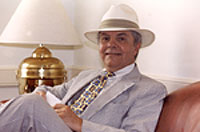
Ralph W. "Scotch" McGill
Chuck, this must have been a well-known school story about the time you came to WRA, as Scotch McGill's Model T, nicknamed the "Hummingbird," was supposedly long gone. I have been unable to find any photo of the Model T that Scotch owned, but it appears in a long story about McGill by Anthony Weitzel at the Akron Beacon Journal, March 28, 1941, which says the following: "He had his master's degree from Columbia in 1929, which was the summer after he arrived in Hudson driving his ancient Model T Ford [named] "The Hummingbird," to teach math and run Cutler Hall."

Librarian Mary Eilbeck
Then Bill Danforth, who delivered the Scotch McGill tribute at the Chapel service in memory of Scotch said this, "I feared, yet revered him during the two years I lived in his dorm. I was amused by the way he could drop one eyelid like a shade, and by his truly wry sense of humor. He had a 1926 Model T, the "Hummingbird," when I arrived, but sold it in 1931 to Mary Eilbeck and Blanche Snyder, calling it "the only flivver you can drive without a horn because it generates its own
Librarian Mary Eilbeck
clamorous reverberation." There is solid documentation for Ralph "Scotch" McGill's Model T. It really was not an ancient car in 1928 or '29 when he rolled into Hudson with his newly-minted master's degree from Columbia University's Teacher's College. Nor was it that old (about five years old) when he sold it to Mrs. Mary Eilbeck who served as Librarian at WRA, 1925 to 1945. She did live on campus, and apparently shared the Model T Ford with Blanche Snyder, a close friend and Secretary to Headmaster Ralph E. Boothby, and later to Harlan N. Wood when he was interim Headmaster, 1929-1931. Miss Snyder was here from 1925 to 1938 and had served as assistant to Mr. Boothby at the Park School in Cleveland Heights before he became Headmaster of WRA.

Blanche Snyder
In the summer of 1929 Mrs. Eilbeck and Miss Blanche Snyder went to Europe together for a vacation of six weeks that included stops in Paris, London, and Glasgow where they boarded the "Duchess of Richmond" ship bound for Canada. They came home by way of Montreal and Mary Eilbeck stayed on in Canada with friends for a few more days. While checking the files in the WRA Archives for additional information on Blanche Snyder, I found a newspaper clipping from the Reserve Record dated March 4, 1932, headlined "Rescue Miss Snyder as Aphrodite flames." The story mentions that Miss Snyder was driving "her well-worn Model T down College Street with her differential burning merrily." I believe this is the same Model T Ford that she and Mrs, Eilbeck had purchased from Scotch McGill the previous year, but which had been renamed "Aphrodite." Miss Snyder was rescued by "Ford expert Bob Chambers" (Charles Robert Chambers, Class of 1932). The account says that Chambers leaped aboard the craft, stopped the car, "and gallantly assisted its occupant to alight." It says that Chambers then organized "a volunteer fire corps" which brought water from the [Dining Hall] kitchen and "grimly battled the flames, confining them to the differential." Afterward, "the quick-thinker Chambers declared, 'Anything to help a lady in distress'." Whether the Model T Ford, called alternately "Hummingbird" or "Aphrodite" survived to drive another day is not recorded, but we suspect that it did.

Thursday, April 05, 2018

La Wilson: Her Life and Art


La Wilson passed away on March 30, 2018, at her home on the north end of College Street in Hudson, where she had lived for many years. It was here that artist La Wilson (born Mary “La” Purcell in 1924) produced the original art work that made her one of the leading names among modern American artists. She had a long association with Western Reserve Academy, not only from the proximity of her home, but because her father-in-law Robert S. Wilson, longtime President of the WRA Board of Trustees, was the namesake for the science building, Wilson Hall, and her former husband, David H. Wilson ’38, was a member of the Board of Trustees, and his and La’s two sons, David H. Wilson, Jr ’63 and Dr. Robert S. Wilson ’65, are both graduates of the school.

Artist La Wilson at the Moos Gallery Show,
spring 1987, courtesy of WRA Archives
La Wilson began taking art lessons at the Akron Art Institute in 1954, the year her third child, Jenny, was born. Initially she did drawings and student pieces, but at the suggestion of Art Director Leroy Flint, she began creating three dimensional art constructions, which became the medium that La’s work would take for the next several decades. After three of her entries in the Annual Juried Exhibition at the Akron Art Institute won awards in 1967, she became friends with John Davis, who offered her a show at his Akron Gallery and became something of a mentor for her. La went on to exhibit all over the country, including in John Davis's gallery on Broadway Avenue in New York City.
WRA Trustee Willis I. Else looks at one of
La Wilson's larger productions at Moos Gallery,
courtesy of WRA Archives
In the spring of 1987, Western Reserve Academy opened its Moos Gallery at the Knight Fine Arts Center, and La Wilson was the featured artist at that time. She exhibited 22 works, all done in the 1980’s, and at that time art critic David J. Ewers wrote about this gallery show in a short article titled, “Seeing La Wilson’s Art”. In it he said that La Wilson’s work “defies categorization and defies the traditions of modern art history”. Ewers wrote that La’s “art is the result of her creative process unhindered by the baggage of the past, unrestricted by the philosophies dictating the present”. He made the point that children genuinely enjoy La Wilson’s art, to which the delighted artist responded, “they get it right away”.
WRA art teacher Tom Armbruster (back to camera) talks to artist
La Wilson about one of her box creations at the Moos Gallery show,
courtesy of WRA Archives
La Wilson’s neighbor on College Street, Grace Goulder Izant, who also had a long association with Western Reserve Academy, wrote about her artist friend in The Cleveland Plain Dealer and the monumental oak beam that she had placed on the terrace in front of her home. La was also the subject of a 1994 monograph by Elizabeth McClelland, and in 1999 she had a special exhibit at her art dealer, John Davis’s, new gallery in Hudson, New York. La enjoyed the idea of going “from Hudson to Hudson” and her exhibit won her notice by Edward M. Gomez, whose “Arts in America” feature in The New York Times for Feb. 11, 1999, was all about La Wilson and the distinctive art work she created.
"Homage to Jackson Pollock", a piece by La Wilson from the
Akron Art Museum Exhibit, 2014, courtesy of the Akron Beacon Journal
In the spring of 2014, the Akron Art Museum celebrated La Wilson on the occasion of her 90th birthday by mounting an exhibit called, “La Wilson: Objects Transformed,” which was the subject of a long piece about her by art critic Dorothy Shinn in the Akron Beacon Journal. The special exhibit of La Wilson’s work remained on view for four months at the museum. Over the last few years, her work was still seen at the Stanton Harris Gallery in Akron, although there are reports that La Wilson stopped producing her work a few years ago. She died quietly at her home, a historic house in Hudson that once was the home of noted 19th century architect Orrin Porter. A memorial service is scheduled at the Western Reserve Academy Chapel on Saturday, April 7, 2018.

Thursday, March 09, 2017

James W. Ellsworth and the World's Columbian Exposition of 1893

Recently, I gave a talk at the Hudson Antiques Club about WRA's benefactor James W. Ellsworth and Chicago's World's Columbian Exposition of 1893.

I will be giving a similar presentation to the Hudson Heritage Association on Thursday, April 13, 2017, at the Barlow Community Center at 7:30 p.m. The presentation will also include references to The Devil in the White City by Eric Larson and will be taped to show later on Hudson Community Television. This program is open to the public.

The following pictures will be included in my upcoming presentation. The captions depict an interesting time in history, tying together WRA's James W. Ellsworth and one of the most significant events in Chicago's history - the World's Columbian Exposition of 1893.
James W. Ellsworth at age 40, about the time he became a Director of the World's Columbian Exposition of 1893
Bird's eye view of the World's Columbian Exposition at Chicago, 1893
The Agriculture Hall at the World's Columbian Exposition, part of the complex of buildings that gave it the nickname "the White City"
WRA student Ralph F. Portmann '33 with the eagle from the statue of The Republic by Daniel Chester French that stood in the main basin at the World's Columbian Exposition. James W. Ellsworth brought back this eagle and the globe it stood on to his barn at Evamere Farm in Hudson after the Exposition ended. It was used as a decoration for a WRA dance in April 1933.
James W. Ellsworth's Exposition pass. He kept many such souvenirs of the Chicago Exposition of 1893

Wednesday, January 18, 2017

Homer Oscar Sluss Named Head of WRA, 1917


Senior year WRA graduation
photo in 1891
No stranger to Western Reserve Academy, Homer O. Sluss had come to our campus from Louisville in Stark County to complete his undergraduate education, and graduated with the class of 1891. He went on to Western Reserve University in Cleveland where he earned a bachelor’s degree, played football for three years, was on the editorial board for student publications, was elected to Phi Beta Kappa, and served as class president for his senior year. He then returned to Hudson as a member of the small faculty of Western Reserve Academy, then in its “hardscrabble” days. Sluss was a teacher of Latin and Greek, was coach for both baseball and football, and was a dorm master. As one of the WRA publications stated, “In the classroom, on the athletic field, and in the prayer room the influence and enthusiasm of Mr. Sluss have been equally felt”. In Lucien Price’s classic booklet, Hardscrabble Hellas, Sluss is the “heroic schoolmaster” who made those years golden despite the shopworn condition of the campus and its buildings.

The WRA football team of fall, 1895, when Mr. Sluss was coach and manager.
When the school closed in the summer of 1903, Mr. Sluss found his services were sought by Governor Dummer Academy in Massachusetts, reputedly the oldest boarding school in the country. He taught German and the classics at this school for a year, then returned to Ohio where he taught in Cincinnati. Eventually he became Superintendent of Schools for Covington, Kentucky, with authority over three high schools. When his old alma mater reopened in 1916, he was contacted about returning to Hudson, but remained in Covington until the crisis over a Principal at WRA persuaded him to take the position. He arrived in Hudson in the spring of 1917 and served as Head of the school until he was dismissed in 1924.

Homer O. Sluss as
Principal of WRA in 1917
Homer O. Sluss was just as popular among the students and faculty as he had been when he was a teacher some years ago. Even the yearbook, The Academic, was dedicated to him in 1924 citing his “understanding, justice, and cheerfulness”. But these were difficult years of transition, and the Board of Trustees decided they were looking for a leader with fresh ideas when they told Mr. Sluss that he was to be replaced by Ralph E. Boothby. Sluss was a married man with two young children when he found himself without a job in the late spring of 1924. James W. Ellsworth, the school’s great benefactor, was reluctant to see Sluss leave, and made sure that the Board provided him with a year’s salary and an opportunity to earn a master’s degree at Columbia University. After completing his degree, Mr. Sluss took a teaching job in Cincinnati where he had met his wife, Rose, but died suddenly in 1928 at the age of 57. The WRA trustees eventually extended a scholarship to the son of Homer O. Sluss, William Blackstone Sluss, who graduated with the class of 1934 and began college at Haverford. While he may not be ranked among the most effective Heads of Western Reserve Academy, Homer Oscar Sluss attained an air of immortality through Lucien Price’s little book, Hardscrabble Hellas, where he will always be the Olympian intellect and athlete and the “hero schoolmaster” to many WRA alumni.