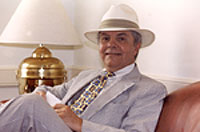
Western Reserve Academy has had nine Headmasters and Heads of School since 1917. Here is a pictorial overview with brief biographies about each of these esteemed leaders throughout much of our school's history.
 |
| Homer Oscar Sluss (1917-1924) |
 |
| Homer Oscar Sluss (1917-1924) |
Homer Oscar Sluss
(1917-1924)
was a graduate of WRA, class of 1891,
followed by a stellar academic career at Western Reserve University where he
was also a star athlete.
He returned to
WRA in 1895 as a teacher of Latin and Greek and stayed on until the school
closed in 1903.
He continued as a
teacher at Governor Dummer in Massachusetts, then as a teacher and
Superintendent of Schools at Covington, Kentucky.
He was persuaded to come back to WRA in 1917
when the school was small and struggling.
He was here when Bicknell Gym and Ellsworth Hall were completed, and
when the decision was made to end co-education at the school in 1925.
He was replaced by Mr. Boothby in 1924, spent
a year at Columbia earning a master’s, and returned to Cincinnati to
teach.
He died at age 57 in 1928.
His son, William B. Sluss graduated with the
class of 1934.
Mr. Sluss is the “heroic
schoolmaster” in Lucien Price’s Hardscrabble Hellas.
 |
| Ralph E. Boothby (1924-1929) |
Ralph E. Boothby (1924-1929) was a graduate of Harvard, 1912, and taught for ten years at St. Stephen’s in Colorado Springs of which he also was Headmaster for seven. He later became Head of the Park School in Cleveland, from which he came to WRA as a candidate of Trustee Harold T. Clark. A proponent of progressive education, Boothby hired Chandler Jones, Ray Mickel, Harrison Kitzmiller, Angus Frew, Ralph McGill and others, and presided over the school when WRA became an all-boys school endowed by the James W. Ellsworth Foundation. He left to become Head of the new Metairie Country Day School in New Orleans where he stayed until 1956 when he retired to Vermont. He died in Weston, Vermont in 1964 at the age of 74. Mr. Boothby was the first to use the term Headmaster.
 |
| Harlan Nims Wood (1929-1931) |
 |
| Harlan Nims Wood (1929-1931) |
Harlan Nims Wood (1929-1931) was a native of Bellvue, Ohio and graduated WRA in 1888. He earned his BA at Amherst in 1892, and eventually an MA also at Amherst. He taught Latin at WRA from 1892 to 1903 when the school closed, and also directed the WRA choir. He studied for a year at Harvard, then he and his wife, Hudson native Georgia Bristol Wood, went to St Johnsbury Academy in Vermont where he taught until 1916 when he returned to Hudson to teach at the newly-reopened WRA. He was a close associate of school benefactor James W. Ellsworth, and when the Board was unable to hire a new Headmaster for the school, Mr Wood stepped in to be Acting Headmaster for two years. Since he was already 60, he opted not to hold the position permanently. He hired Ralph E. Clewell, Harlan Parker, Roscoe J. Theibert, and LaRue Piercy, among others. He served as Dean of the School under Hayden, and continued to teach until his untimely death at age 77 early in 1945. Wood House is named for him.
 |
| Dr. Joel B. Hayden (1931-1946) |
 |
| Dr. Joel B. Hayden (1931-1946) |
Joel Babcock Hayden (1931-1946) was an Oberlin College graduate, class of 1909 who went to eastern Europe on an Immigration Fellowship, 1912-13 after his ordination. He served churches in Baltimore and Cleveland and was Pastor at Fairmount Presbyterian Church when the Trustees decided to name him Headmaster of WRA. He was the first Head of School to live at Pierce House. He hired Brooks Shepard, Paul Roundy, Russell Cleminshaw, Charles Mears, J. Fred Waring, Willis Dodge, Franklyn “Jiggs” Reardon, Mark Worthen, Bill Moos, among others. He was Head during the Depression years of the 1930’s, and through World War II. Dr. Hayden suffered a stroke during his final year, retired to Vermont in 1946 and died at the age of 61 in 1950. Hayden Hall is named in his honor, as is North & South Hayden Parkway in Hudson where the public schools are located on land formerly owned by WRA.
 |
| John White Hallowell (1946-1967) |
 |
| John White Hallowell (1946-1967) |
John White Hallowell (1946-1967) was a member of a distinguished New England family and a graduate of Harvard, class of 1931. He earned his MBA at Harvard, taught at Groton School under the legendary Endicott Peabody, and was a lieutenant commander in the Pacific, 1942-45. He was at Harvard when he was tapped by Trustee Robert Wilson to become Headmaster of WRA, and came to Hudson with his wife and four young children. Among his hires were Richard Clewell, Sherwin Kibbe, Frank H. Longstreth, Elinor Roundy, William H. Danforth ’34, James Gramentine '52, Rollie Waite, William Appling, Harold Donnelly, and James Fraser. During his time the Memorial Gym was built, as was Wood House in 1953 and Wilson Hall in 1963. Hallowell retired to Cape Cod and died suddenly at age 71 in 1980. Until surpassed by Skip Flanagan, his service at 21 years had been WRA’s longest.
 |
| Henry Payson Briggs (1967-1976) |
 |
| Henry Payson Briggs (1967-1976) |
Henry Payson Briggs (1967-1976) earned his BA at Harvard, Class of 1954, and his MA also at Harvard, 1959, serving in the U.S. Army as an officer 1954-56. He taught briefly at the Woodside School in California, then was in Admissions at Harvard, serving on the Ford Foundation Project in Boston when he was hired as Headmaster at WRA. Among his hires were Russ Hansen, Richard Jones, Dale Conly, Lee Blankenship, Marie Fiedler, Louis Turner, Corky Davis, Anne Chapman, Velia Pryce, and Business Manager Leonard Carlson. He was here during the difficult transition to coeduction in 1972, and was Headmaster when the school purchased the David Hudson House in 1968 and during the Sesquicentennial year 1975-76. Briggs was also here during the Vietnam War years. He went on to Head the Seven Hills Schools until 1996 when he retired and did substitute Head at several schools. He is still living in the Cincinnati area in 2018.
 |
| Hunter M. Temple (1976-1982) |
 |
| Hunter M. Temple (1976-1982) |
Hunter M. Temple (1976-1982) earned his BA at Colgate in 1959, a MAT at Purdue, and a MEA and Ph.D at Stanford. He taught history at the Punahou School in Hawaii for eight years, then was at the University of Hawaii for two years, and a private learning system in Reno, Nevada from 1971-76 before being hired as Headmaster at WRA. The noted television film, “The Gathering” was made at Pierce House and elsewhere on campus and in Hudson, 1977. Dr. Temple presided at the dedication of the Frost Observatory in 1981. John D. Ong became a trustee of WRA during his tenure and was Board President when Temple resigned and went to California where he had a long term as Headmaster of the Brentwood School, Los Angeles, 1982-2002. He is still living in southern California in 2018.
 |
| Henry Edward Flanagan, Jr. (1982-2008) |
 |
| Henry Edward Flanagan, Jr. (1982-2008) |
Henry Edward Flanagan, Jr. (1982-2008) is a native of Maryland and a graduate of Rutgers, 1966, earned a MA and Ph.D at the University of Michigan and an MED at Harvard in 1981. He had taught and coached at the Peddie School in New Jersey, and was a teacher of English, History, Classical studies, and was a lacrosse coach at Avon Old Farms School in Connecticut for about ten years before being selected in 1982 as the Headmaster of WRA. During his long tenure, he hired many faculty and staff members, and is often cited for the number of new buildings that went up during his stewardship including the Knight Fine Arts Center (1985), the renovation and opening of the Nathan P. Seymour House (1998), the Harry E. Metcalf Center (1999), the John D. Ong Library (2000), Long House (2000) the total renovation of Wilson Hall (2001), the Murdough Athletic Center (2004), Morgan Hall (2004), as well as other projects such as expansion of the WRA curriculum, its faculty, and its international program both for students of WRA and those coming from other countries. Dr. Flanagan also served as the Head of the Boarding Schools Association. His 26 years is the longest in WRA history. He and his wife, Britt, who had ably served as Director of Admissions here at WRA, returned to Connecticut where Flanagan became a Dean at Avon Old Farms, taught history, and coached the boys' lacrosse team through 2018.
 |
| Christopher David Burner in 1998 at WRA |
 |
| Christopher David Burner (2008-2019) |
 |
| Christopher David Burner (2008-2019) |
Christopher David Burner (2008-2019) grew up in Hudson and is a graduate of WRA, Class of 1980. He earned his BA at Franklin and Marshall College, an MA at Dartmouth, and a MED at Harvard. He taught Latin at St. James School in Maryland for a couple years, returned to WRA in 1986 to teach Latin and be Assistant Dean of Students. He was at the Westminster School in Connecticut 1989-1992, then returned to WRA as a teacher, Director of Admissions and Financial Aid until 2001, when he became Dean of Faculty and Administration, where he served until being named Head of School at WRA in 2008. Mr. Burner also named a number of new faculty and staff, increased the responsibilities of Advancement and Communications, and was responsible for the successful conclusion of the largest Capital Campaign in the school’s history. He worked with the Board and staff to renovate the buildings along WRA’s historic Brick Row. A year-long renovation of the Athenaeum (1843) resulted in a totally new residence hall for young women. Another couple years was spent in planning and executing the renovation of the President’s House (1830) into our new Admissions Office, dedicated in 2017. A 14-month renovation of Seymour Hall (1914), our main classroom building which had been used for over 100 years, was completed in August, 2018 and reopened with more classroom space, new quarters for teachers, and a whole new feeling about this historic building which is a key structure on campus. The restoration project on Brick Row is likely continue under the next Head of School. Mr. Burner will serve as the Head of School at Nichols School in Buffalo, NY, beginning in July of 2019.